Loose Display or Ordered Shelf? Two Ways to Arrange a Collection
Choose loose display or an ordered shelf for your collection by matching the arrangement to how you handle objects, make comparisons and enjoy the view.
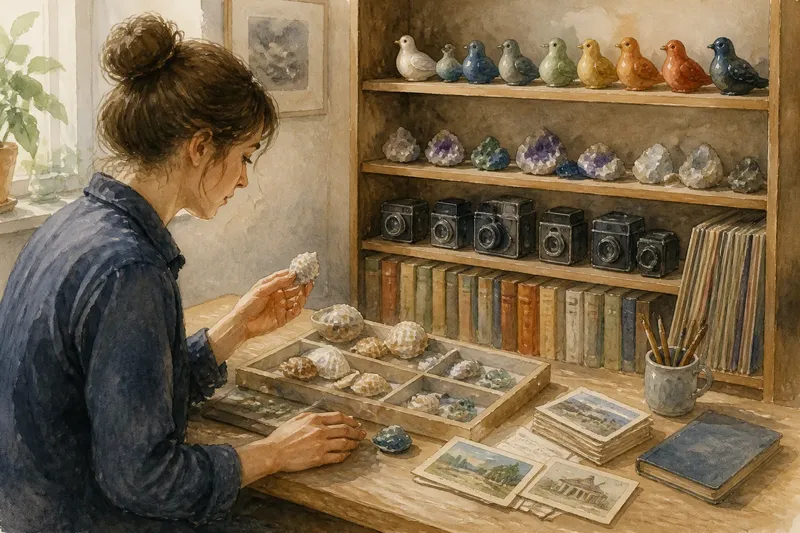
A collection arranged for quick access should make each object easy to pick up; an ordered shelf should make relationships between objects easy to see. That distinction is more useful than asking which display looks tidier. Choose according to what you want to do when you approach the collection.
Loose display suits handling and browsing
A loose display keeps objects visible without requiring a fixed sequence. Pieces might sit in shallow trays, on an open shelf, or in small groups on a desk, with enough room to lift one without shifting several others.
This arrangement fits collections that invite frequent handling or informal browsing: shells, small toys, fabric swatches, postcards, or found objects from walks. It also suits a collection whose categories are still changing. If you are unsure whether a new piece belongs with the blue glass or the beach finds, a flexible arrangement lets you move it while you decide.
Loose does not mean careless. Keep fragile pieces apart, avoid stacking objects that can scratch one another, and leave a clear place to return each item. A shallow tray can gather small pieces while preserving the sense that they can be moved around.
Choose loose display if you often take items out, compare them by feel, or add new pieces without wanting to reorganise everything. The practical test is simple: can you reach the object you want without disturbing its neighbours?
An ordered shelf makes patterns legible
An ordered shelf gives objects a visible structure. You might arrange them by material, colour, maker, subject, size, or the place where you found them. The organising principle matters less than applying it consistently enough for a viewer to understand the grouping.
This approach suits collections that are satisfying to scan as a whole. A row of ceramic birds might be grouped by glaze colour; a set of maps might be arranged by region; records might be ordered by artist or listening mood. A clear order lets similarities and differences stand out, even when individual pieces are rarely handled.
Ordered display can also make a collection easier to maintain. If each item has a place, a gap is noticeable and returning an object becomes straightforward. But the system may feel restrictive if the collection changes often or if you prefer to bring pieces together for reasons that are not part of its official categories.
Choose an ordered shelf if you enjoy comparing pieces in place, showing a deliberate visual sequence, or finding items through a stable category. Use labels only when they help a visitor understand a distinction that is not obvious from the arrangement.
Match the arrangement to the collection’s daily use
Think about the moment you most often spend with the collection. Do you take one object down to examine it, or stand back to notice how the group looks? Do new acquisitions need a temporary home, or do you prefer each addition to be fitted into an established pattern?
- Frequent handling: favour open space and reachable groups, especially for objects you pick up regularly.
- Visual comparison: use a stable order when differences in colour, shape, subject, or origin are part of the pleasure.
- Ongoing additions: leave room for change, or choose a category that can expand without forcing a full rearrangement.
- Limited display space: keep the pieces you most enjoy seeing together and store the rest safely, rather than crowding every item onto one surface.
- Shared viewing: make the arrangement easy for another person to read, with clear groupings and an accessible viewing height.
Say you collect paper theatre tickets and often pull them out to remember an evening. A loose arrangement in divided sleeves would make browsing easy, while a strict chronological row might better suit someone who enjoys tracing the sequence of performances. The same collection can support either choice; the deciding factor is what its owner wants to notice.
Combine access with visual order when one method falls short
The choice need not be absolute. A collector might arrange books by subject on the main shelf, then keep frequently consulted titles on a nearby open ledge. Someone with mineral specimens could group them by colour in a cabinet while leaving a small tray for pieces being examined or newly acquired.
A useful hybrid has a clear boundary between its two purposes. Keep the permanent display orderly, and give active or undecided objects a separate, modest space. Without that boundary, the temporary area can gradually become an unplanned second collection that is hard to browse.
Materials and placement affect the decision too. A shallow drawer or lidded box can protect delicate objects while allowing quick access; an open shelf makes a visual arrangement easier to appreciate. For fragile, valuable, or light-sensitive items, follow the maker’s care instructions or ask a suitable conservator about appropriate display conditions.
Which arrangement fits your situation?
Should I arrange a collection by colour or by type?
Arrange by colour if the visual relationships are what you most enjoy seeing. Choose type when knowing what each object is, or comparing objects with the same function, matters more than the overall palette.
Is a loose display suitable for a fragile collection?
It can be, if loose means accessible rather than crowded or unstable. Use a secure surface with enough separation to prevent pieces from knocking together, and avoid a layout that invites accidental brushing.
What should I do when a collection keeps growing?
Leave a little room for new pieces or use an arrangement that can expand by group, such as adding another tray or shelf section. If space is fixed, decide which objects deserve display and keep the remainder stored in a way that preserves access.
Can I change the arrangement later?
Yes; an arrangement is a way of using a collection, not a permanent classification. Take a photograph before moving a carefully ordered display if you want to remember its sequence, then try a different structure and notice whether it changes how you browse.
Let the first arrangement answer a real need
Start with the objects you reach for most or the relationship you most want to see, rather than arranging everything at once. If the display makes those objects easier to handle or the pattern easier to read, it is serving its purpose. Revisit the choice when your habits change; a collection can be both a set of things and a way of spending time with them.