The Parlour Game Before the Party Game
Parlour games began as adaptable household amusements. See how spoken play, written rules and shared materials shaped a distinctive form of home leisure.
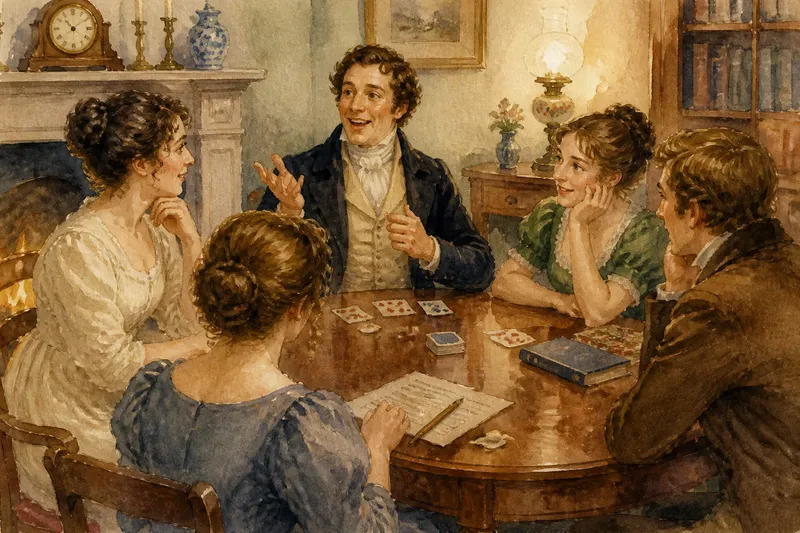
Parlour games began as adaptable household amusements, not as a single product with a fixed set of rules. In Britain and elsewhere, people could make a pastime from spoken riddles, guessing, songs or wordplay, while later printed collections and game materials offered ways to repeat particular forms of play.
Parlour games took shape within the household
The parlour was a room for receiving visitors and spending time together, but its furniture and customs varied between households. A spoken riddle or guessing game needed little preparation; a card game required a pack and a suitable surface. The choice of activity was shaped by what was available and by what the company considered appropriate.
Many informal games depended on people remembering or explaining their rules. A prompt could be altered as play went on, and the person who introduced it often influenced its tone. That flexibility made the activity easy to adapt, but it could also leave newcomers unsure about how to join.
Riddles, word games and charades made different demands. A riddle asked people to listen and solve; charades involved acting and watching; a guessing game could direct attention towards an object already in the room. Each offered a different balance of speech, observation and performance.
Conversation games made turns part of the amusement
Some parlour games gave conversation a simple pattern rather than a winner. Players might answer a shared prompt, add a sentence to a story or take turns naming items in an imagined collection. The rules organised who spoke next, while the participants supplied the ideas.
Turn-taking could make a game easier to follow, but it did not ensure that everyone enjoyed the subject or the attention. A prompt about travel might invite an easy exchange, while a question about private matters could put someone on the spot. The content mattered as much as the rule.
Imagine a household with neighbours visiting after supper and no materials set out. One person starts a spoken round: each participant names an object for an imaginary travelling trunk and explains the choice. The action gives the group a shared thread of conversation; if the replies become brief or people turn to other topics, the round can simply stop.
Written rules helped games travel between households
In the eighteenth and nineteenth centuries, printed collections of games and books of amusement circulated in Britain. These publications recorded instructions for activities that could otherwise be learned orally or adapted within a household. They are useful evidence of games being described and made available to readers, though a printed rule does not tell us how often every household played it.
Written instructions could clarify a turn order, a goal or the way to decide a result. This gave players a shared reference when learning a game beyond the circle in which they had first encountered it. It did not make every version identical: players could still simplify instructions, change prompts or follow a familiar local variation.
Materials also made some procedures easier to repeat. Cards, counters, boards and pencils gave players visible tasks and helped mark progress. Their presence did not replace sociability; it directed attention towards a common activity and made its rules tangible.
Designed games brought a more defined structure
A game with prepared rules and materials usually had a clearer beginning, sequence and finish than an improvised exchange. It might assign teams, require players to draw or move pieces, or set a task to complete. Such formats became part of domestic leisure alongside conversation games, rather than simply displacing them.
Different formats suited different kinds of attention. A board or card game asked players to keep track of turns and outcomes; a spoken riddle could begin and end in a moment. A game involving acting or drawing called for space and a willingness to perform, while a quiet guessing game did not.
These distinctions help explain why parlour play cannot be described as a steady progression from casual amusement to elaborate entertainment. Households could use several forms in the same period, choosing according to available materials, company and custom.
What distinguishes parlour games from other home amusements?
What made a parlour game different from ordinary conversation?
A parlour game introduced a shared prompt, turn or goal, giving an exchange a recognisable pattern. The structure could be light, as with taking turns on a riddle, or more formal, as with a board game.
Why were printed rules useful?
Printed rules gave readers instructions they could consult and share beyond the household where a game was learned. They also recorded particular versions, although play could still vary between groups.
Did parlour games always involve competition?
No. Story-building, riddles and conversation prompts could organise play without ranking participants. Other games made winning or completing a task central to the activity.
What do household games reveal about leisure history?
They show how leisure could be organised through conversation, shared objects and agreed rules within domestic life. Printed descriptions reveal what writers chose to record, but they cannot by themselves establish how widely each game was played.
Materials and manners influenced the form of play
Equipment affected how a game could be played. Cards and counters were portable; drawing and acting required different kinds of space and participation. These practical differences shaped the character of an activity without determining whether it would be enjoyed.
Household manners also mattered. A game based on imitation or personal disclosure could be welcome among close relations and uncomfortable in another company. Age, familiarity and expectations around privacy influenced how people responded, even when the written rules stayed the same.
Adaptation was part of the history of play. A group could shorten a round, change a prompt or let someone watch before taking a turn. Such choices help explain why a game might survive in a household without being followed exactly as printed.
Parlour games connected custom with recorded rules
Parlour games belonged to a broad domestic tradition rather than a single origin story. Spoken amusements drew on memory and company; printed instructions and reusable materials made particular activities easier to describe, share and repeat. Both informal customs and designed games remained part of home leisure.
The phrase parlour games covers activities with different histories and demands, from riddles to games played with boards or cards. For anyone searching for the history of parlour games, the useful distinction is not simply between old improvisation and newer design, but between the ways people learned, recorded and adapted play within the household.
When reading a printed game collection, treat its instructions as evidence of a recorded version, not proof that every household played in the same way. That distinction keeps the history grounded in what the sources can show while leaving room for the local customs they rarely captured.